
Are There Enough Phone Calls to Go Around for Hundreds of New Voice AI Vendors?
Calling minutes are not disappearing. European usage has shifted toward online platforms, while India’s regulated calling market continues to grow.

The telephone is exciting again—and not because it turned 150 this year. Based on a research database I built earlier this year, there are more than 400 dedicated Voice AI vendors offering speech-to-speech agents with some phone-interaction ability. At least 175 are startups founded within the last 3 years, and I keep finding new ones. These counts are in addition to the hundreds of established unified communications and contact center providers that are also using Voice AI—or will be soon.
That is a whole lot of companies. This got me wondering: Are there enough phone calls to justify so many vendors? Do people still even talk on the phone unless they have to? When I last tracked this many years ago, telephone usage in mature markets was declining because of messaging and social media. Businesses were pushing customers away from phone calls toward cheaper messaging channels. Do we have a doomed-from-the-start situation, with a growing number of vendors chasing a shrinking market?
To examine this, I went on a side quest to quantify the total number of minutes people spend talking on the phone in a year. National telecom regulators publish a tremendous amount of data. Fortunately, AI makes it possible to read and normalize all of it in a reasonable amount of time. Rather than focusing on lines or subscribers that may not be used, I focused on actual Minutes of Use (MoU). This work is not done yet, but I wanted to share a few interesting findings so far.
Online communications have preserved calling in Europe
Many of us still spend a lot of time on calls because of apps. Regulations vary by country, but in general there are 2 major classes of service:
- Regulated communications services: fixed-line and mobile cellular services left over from the earlier days of telecom—AT&T, Telefónica, NTT, etc.
- Unregulated communications apps: calls between apps that exist because of the Internet—WhatsApp, Apple FaceTime, Facebook Messenger, Microsoft Teams, Google Meet, etc.
The unregulated category goes by many names: VoIP apps, over-the-top (OTT) apps, and Number-Independent Interpersonal Communications Services (NI-ICS). None of these are great. I prefer the name used by the UK’s Ofcom: Online Communications Services (OCS).
Regulated data is abundant, although it is not universal and quality varies considerably by regulator. OCS data is rigorously quantified by only a few regulators, but that is starting to change. I aggregated some of this usage data from regulators in the UK, Germany, and Austria:
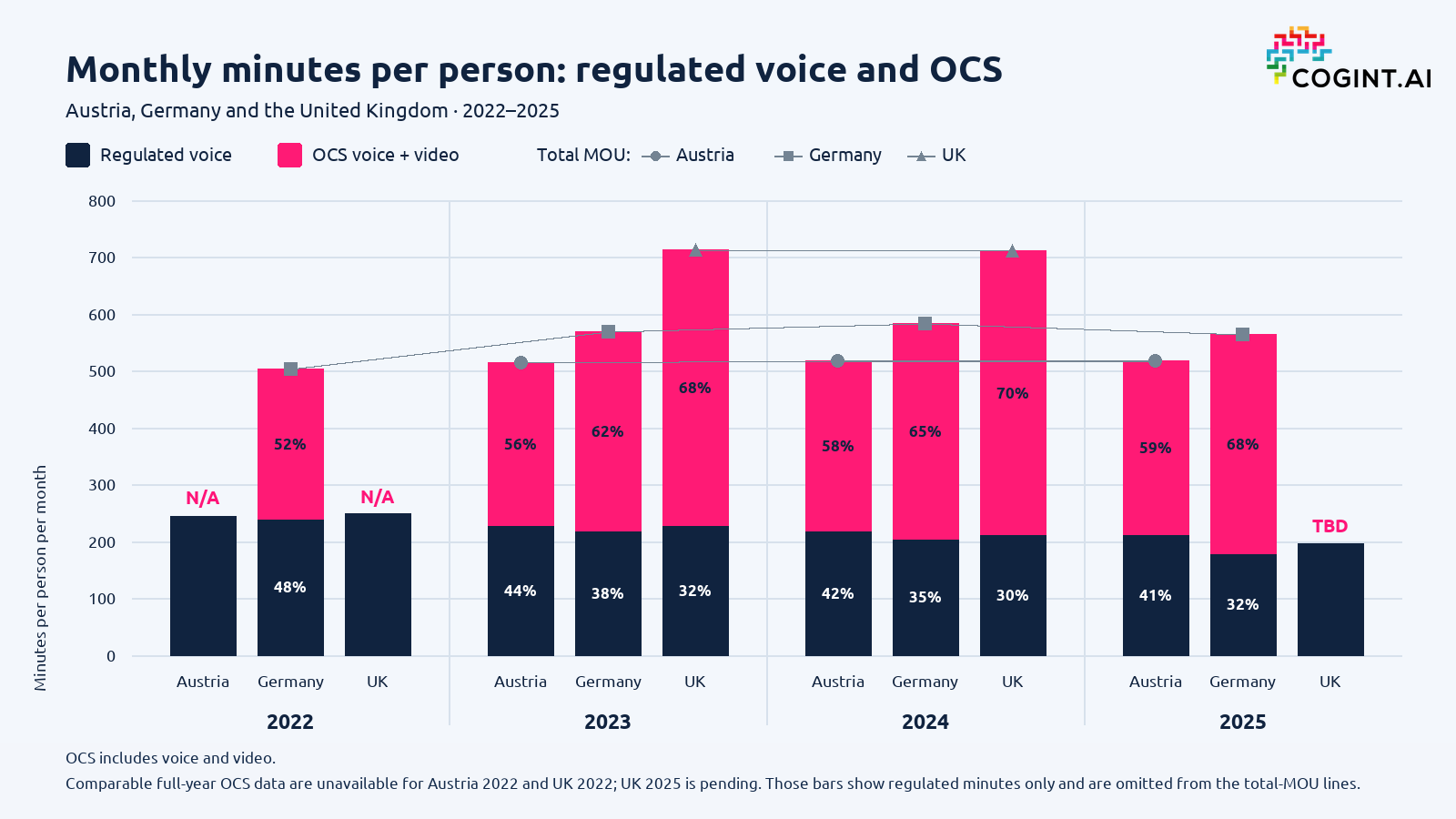
This reveals a few things in these markets:
- OCS is larger than regulated usage—1.4× to 2.4× as many minutes in this sample.
- Regulated voice is slowly declining—down 7% to 18% per person since 2023.
- Aggregate usage has flatlined—2024 figures were mostly flat compared with 2023.
It is also worth noting that regulated usage is surprisingly consistent across these European markets, while OCS usage varies more significantly by country. The average Briton spends about 1.6% of their life on calls, compared with 1.4% for Germans and 1.3% for Austrians. There may be some methodological differences—they ask major OCS providers to share country-level data—but within Europe, BEREC has encouraged normalized data collection across member countries.
India is the biggest calling market
India is remarkable not only because of its huge population, but because it is the most talkative. India has had incredible MoU growth in recent years even though its voice subscription count has changed little.
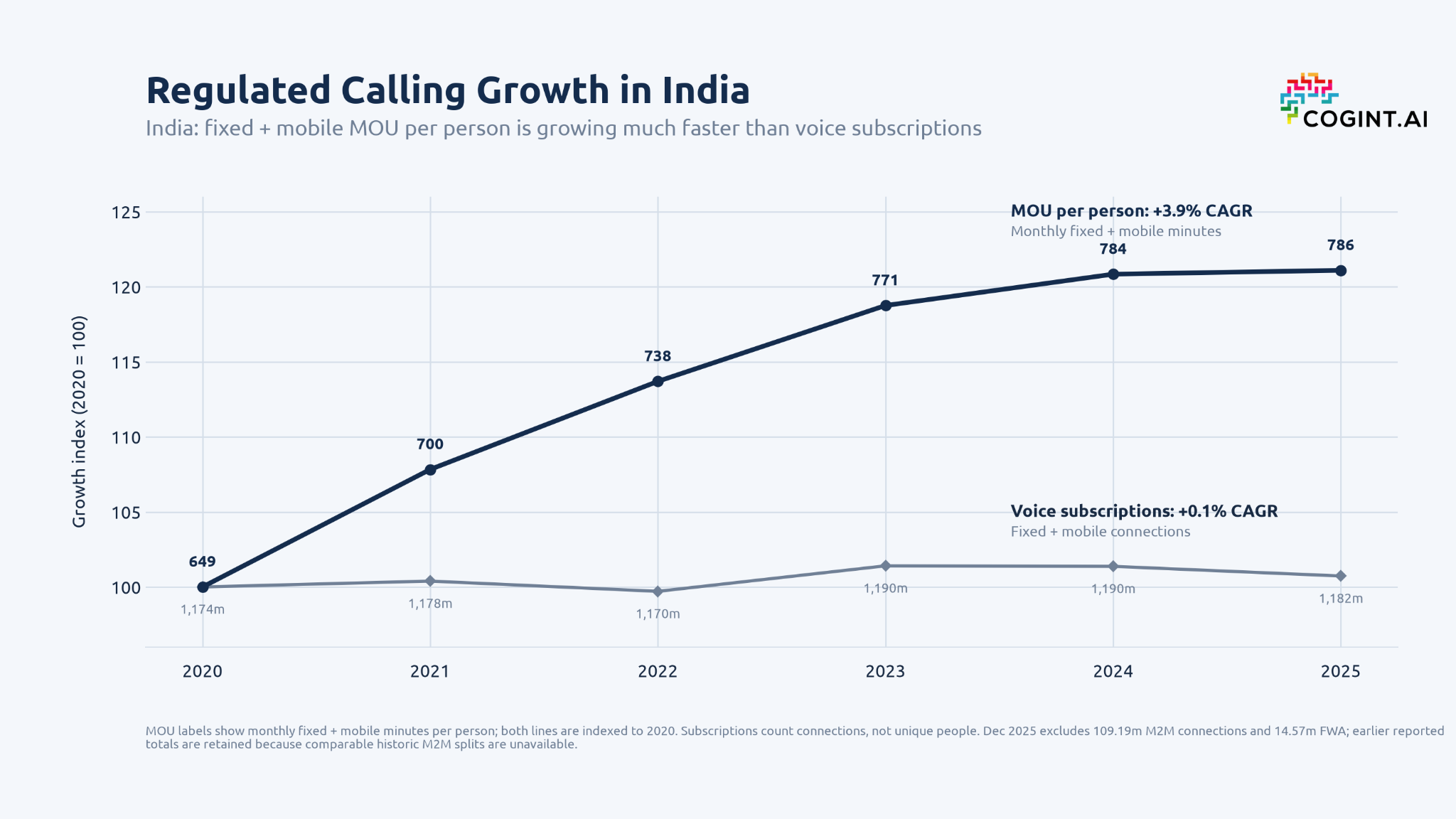
This growth is largely due to a shift by Indian carriers to unlimited voice plans. Dropping the incremental price of making more calls uncovered latent demand that had been held back by price sensitivity. Unlike other markets, India never had a large fixed-line population. Almost all connections are mobile, and mobile accounted for roughly 99.8% of 2024 calling minutes by my calculations.
Also unlike most markets, India has unusually high regulated usage. OCS figures for India are not reported. OCS is certainly an incremental traffic driver, but I do not expect it to exceed regulated traffic as it does in the European markets above. Regulatory barriers, market-entry challenges, Internet penetration, and the prevalence of regulated usage likely lead to lower OCS usage. In addition, there is only so much time in the day. India ranks ahead of most countries in MoU per person even without including OCS traffic. In my estimates, India has more calling minutes per person than any other country.
Implications for Voice AI
Calling is healthy
My research shows calling is very healthy, possibly even reaching new peaks in 2025—largely because of calling-volume increases in India and Africa and shifts to OCS. Calling is holding up against messaging and social media channels. There may still be a case that there are too many Voice AI companies, but at least they are not competing for a shrinking number of minutes.
Online communications are big, but harder to capture
While there are differences between countries and plenty of implementation concerns, regulated calling is more or less standardized around protocols such as SIP. The public telephone network is open—any phone number can theoretically call any other phone number. From a technical perspective, this makes regulated telephony an ideal place to start with Voice AI, since the same infrastructure can address a population of many billions of users. However, in most higher-income countries, regulated telephony represents a shrinking fraction of the Online Communications Services market.
OCS calling is fragmented across hundreds of apps, and each app controls access to its users. Some major apps provide limited access. Meta’s WhatsApp—easily the largest OCS provider—offers APIs that can support Voice AI, but developers are subject to WhatsApp’s guidelines, which can change. Other OCS apps, such as Apple’s FaceTime, offer no third-party access at all.
India is a great place for Voice AI
India looks like an especially strong market for calling-based Voice AI. First, its huge population makes it one of the largest markets. On top of that, India is the most talkative on a per-user basis, with sustained usage growth, although that growth is slowing. Finally, most of India’s calls use the public telephone network, so there are no walled gardens preventing access to those callers.
Final thoughts
Phone calls are clearly not disappearing. In mature European markets, they are moving from regulated networks to online platforms. In India, regulated calling itself remains enormous.
This does not mean the market can support hundreds of new Voice AI vendors. It does mean that a general apathy toward calling is unlikely to cause widespread market failure.
I hope to finish my MoU quantification research with more regional detail and country highlights. As shown above, OCS appears to account for the largest share of calling minutes in many markets. Unfortunately, it is also the hardest segment to quantify, which is slowing me down. Please let me know if you are interested in more of this kind of research and analysis.